On this page
- How do the tools compare?
- What does SAFER-HOME measure?
- What does the HSSAT cover, and is it free?
- What is the Westmead Home Safety Assessment, and is it free?
- What does the I-HOPE measure?
- What is CASPAR used for?
- What does HOME FAST screen for?
- What does the Housing Enabler measure?
- What does the HEAP assess?
- How do you choose a tool?
- Common questions
- Sources
Eight widely cited home safety assessment tools for occupational therapists are compared here: the SAFER-HOME, the Westmead Home Safety Assessment (WeHSA) and the HOME FAST are observational tools a clinician completes in the home; the Home Safety Self-Assessment Tool (HSSAT) is a free booklet the older adult or family completes; the I-HOPE is a performance-based measure of how the home affects daily activities; CASPAR collects the client and home information a team needs to specify a home modification; the Housing Enabler rates accessibility as the fit between the person and the home; and the HEAP is built for the homes of people living with dementia. A 2018 systematic review of 19 home hazard instruments named the HOME FAST, HSSAT, I-HOPE and WeHSA as the instruments "with high potential for evaluating home hazards associated with falls" (Romli et al., PubMed 29415567).
The tools serve different purposes. A falls screen counts hazards. A performance measure rates how well a person does activities in their own space. A modification intake records measurements and goals for a designer or contractor. Pick the tool by the decision the assessment has to support.
How do the tools compare?
| Tool | Who administers | Format | Items | Time | Cost and access | Reported reliability (study size) |
|---|---|---|---|---|---|---|
| SAFER-HOME v.3 | Occupational therapist | Interview and observation of tasks in the home | 74 (v.3) | Not stated by the developer | Manual sold through VHA Home HealthCare | v.2 (93 items): internal consistency alpha 0.86 |
| HSSAT v.5.0 | Older adult or family; separate checklist for professionals | Self-assessment booklet | Not stated by the developer | Not stated | Free PDF from the University at Buffalo | Test-retest ICC .97, inter-rater .89 |
| Westmead Home Safety Assessment (WeHSA) | Occupational therapist | Observation on a home visit | 274 hazards in 14 areas | Not stated | Kit sold by Coordinates Publishing | Inter-rater kappa above 0.40 for all items |
| I-HOPE | Trained rater, usually an occupational therapist | Performance-based, picture cards and observation | 44 activities | About 60 minutes | Sold by Washington University; signed copyright notice | Inter-rater ICC .99 to 1.0 (10 clients) |
| CASPAR | Health or building professional | Client interview, home description, photos and measurements | 6 sections | Not stated | Free PDF on homemods.org | No PubMed validation abstract found |
| HOME FAST | Health professional (HP) or older person (SR) | Observation checklist; self-report version | 25 (HP); 87 (SR) | Not stated | Manual free from the University of Sydney | Inter-rater kappa 0.62 (40 home visits) |
| Housing Enabler | Occupational therapist or other trained rater | Person's functional limitations plus observation of barriers in the home | 15 limitations; 188 barriers | Not stated | Sold by its developers | Agreement 91% for limitations, 85% for barriers, kappa 0.50; good agreement across 106 cases in a Nordic study |
| HEAP | Occupational therapist or trained rater, with the caregiver | Observation walk-through of the home | 192 | Not stated | Revised HEAP-R by permission request to the University of Florida | Hazard index ICC 0.36 to 0.66 (22 homes, 4 raters) |
Sources for each row are in the sections below. "Not stated" means the developer's page and the validation abstract read for this page did not give a figure. The reliability figures use different statistics and come from studies of very different sizes, from 10 clients to 40 home visits, so they cannot be ranked against each other.
What does SAFER-HOME measure?
The SAFER-HOME (Safety Assessment of Function and the Environment for Rehabilitation, Health Outcome Measurement and Evaluation) rates how safely a person carries out functional activities at home, and is built to measure change after an intervention. It was developed by occupational therapists Teresa Chiu, Rosemary Oliver and colleagues at COTA Comprehensive Rehabilitation and Mental Health Services. Their validation study reports that a factor analysis of 1,173 observations produced the 10-factor SAFER-HOME v.2, that "the 93-item SAFER-HOME had an internal consistency coefficient alpha value of 0.86," and that occupational therapists in a pilot found it "clinically useful, practical to administer, and sensitive in detecting changes" (Chiu and Oliver, OTJR 2006).
Version 3 is the current version. A 2016 study that used it describes v.3 as "a 74-item assessment that scores individuals as having no, mild, moderate or severe safety concerns based on interview or observation of household tasks" (Breeden, PubMed 27563389). COTA's website no longer lists the tool. VHA Home HealthCare lists the "Safer Home Manual V.3" on its publications page and sells it through Amazon, as of October 2026.
What does the HSSAT cover, and is it free?
The Home Safety Self-Assessment Tool was created by the Occupational Therapy Geriatric Group at the University at Buffalo (Machiko Tomita, Jo Schweitzer and Susan Nochajski) to help older adults find and fix fall hazards themselves. Version 5.0, launched in January 2017, added the garage. The University at Buffalo page offers the full booklet and each section as free PDF downloads: the self-assessment checklist, fall prevention resources and "how to" fixes, a list of Erie County, New York contractors, and a separate Home Hazard Checklist for Healthcare Professionals.
The psychometric study in the American Journal of Occupational Therapy reports a content validity index of .98, test-retest reliability (ICC) of .97 and inter-rater reliability of .89, with convergent validity against the CDC home safety checklist of r = .65 (Tomita et al., PubMed 25397766). The authors conclude that the HSSAT is "a reliable and valid instrument to identify fall risks in a home environment." The contractor list covers Erie County only, so add local contacts when you hand it out.
What is the Westmead Home Safety Assessment, and is it free?
The Westmead Home Safety Assessment (WeHSA) is an observational checklist that an occupational therapist completes on a home visit to identify fall hazards for older people. It was developed by Lindy Clemson in Australia. Its publisher, Coordinates Publishing, describes it as covering "274 home fall hazzards across 14 places and components of the home environment."
The WeHSA is not free. Coordinates Publishing sells it as the Home Fall Hazards kit, which "contains the Manual, packet 25 assesment forms, pad of 25 safety report forms and laminated prompt sheet." The content validity study reports an overall content validity index of 0.80 (Clemson et al., BJOT 1999). The inter-rater reliability study found kappa above 0.40 for all items in the refined tool, up from one third of items below 0.40 in the earlier version, and the authors stress "the importance of training and clearly defining the domain of interest" (Clemson et al., OTJR 1999).
What does the I-HOPE measure?
The In-Home Occupational Performance Evaluation (I-HOPE) measures how environmental barriers in the home affect what an older adult does there. It was developed by Susan Stark's Participation, Environment and Performance Laboratory at Washington University in St. Louis. According to the lab's I-HOPE page, a trained rater conducts it in the client's home "using a set of 44 cards of images depicting older adults participating in daily activities," and it "takes approximately 60 minutes to conduct." It yields four subscores: activity (the share of activities that are a problem), the client's performance rating, the client's satisfaction rating, and total barrier severity, which is the rater's rating of person-environment fit.
The development study piloted the I-HOPE with 77 older adults before and after an environmental barrier removal intervention, then tested inter-rater reliability with 2 raters and 10 older adults. It reports subscale internal consistency of .77 to .85 and intraclass correlation coefficients of .99 to 1.0, and calls the results preliminary (Stark et al., PubMed 20825129). The lab sells the kit online or by purchase order and needs a signed copyright notice before it processes an order. Training videos are free on request after purchase. The page does not list a price.
What is CASPAR used for?
CASPAR (Comprehensive Assessment and Solution Process for Aging Residents) collects what a team needs to recommend a home modification: the client's abilities, goals and problem tasks, and a description of the home. The homemods.org listing says it was "developed through two Small Business Innovation Research grants by researchers at Georgia Tech and the company Extended Home Living Solutions," and that it "can be used by building professionals and health care professionals (e.g., occupational therapists)."
The form, a free PDF on homemods.org, has 6 sections: contact information, client information, problems in the home, client goals, description of the home, and summary information. It lists a camera and a 25 ft (7.6 m) or longer tape measure as the materials needed. The developers described its development in Physical and Occupational Therapy in Geriatrics (Sanford et al., 2002). No PubMed-indexed abstract that reports reliability or validity figures for CASPAR by name could be found for this page, so treat it as a structured intake form rather than a validated outcome measure.
What does HOME FAST screen for?
The Home Falls and Accidents Screening Tool (HOME FAST) screens older people for increased falls risk from hazards in and around the home. It was developed by Lynette Mackenzie in Australia and has 25 items. The inter-rater study ran 40 home visits in the UK, in which occupational therapists, occupational therapy assistants and a social worker each rated a home alongside an expert rater. It reports "overall kappa value for the checklist was 0.62, indicating a fair to good level of agreement," with "hazardous outside paths" the only item with poor agreement (kappa 0.30) (Mackenzie et al., PubMed 12004972).
A self-report version, the 87-item HOME FAST-SR, converts to an equivalent score on the 25-item health professional version (HOME FAST-HP). In 568 Australian women, fallers had significantly higher HOME FAST scores (Hassani Mehraban et al., PubMed 20554430). The University of Sydney repository holds the HOME FAST manual (2019) as an open access PDF, with scoring guidance, descriptions of the 25 items and copies of each version.
What does the Housing Enabler measure?
The Housing Enabler, developed by Susan Iwarsson and Björn Slaug in Sweden, rates accessibility as the fit between a person's functional limitations and the barriers in their home, rather than fall hazards alone. The rater records the person's functional limitations on 15 items and checks the home against 188 environmental barriers in four areas: outdoors, entrances, indoors and communication (Rantakokko et al., BMC Public Health 2013). A reduced set of 61 environmental items was the starting point for a shorter screening version (Rantanen et al., BMC Public Health 2012).
A reliability study reports mean agreement of 91% on the personal items and 85% across all 188 environmental items, with kappa 0.50 (Iwarsson et al., PubMed 16389996). In a Nordic study, 20 occupational therapists rated 106 cases in pairs and found good overall agreement, with kappa values that varied enough for the authors to call for further study (Helle et al., PubMed 20078255). The developers hold the copyright and sell it as a commercial product; no current price list was found for this page.
What does the HEAP assess?
The Home Environmental Assessment Protocol (HEAP), developed by Laura Gitlin and colleagues, assesses the homes of people living with dementia. Its 192 items are summed into indices for hazards, adaptations, and clutter and comfort across eight areas of the home. In the reliability study, four raters, two environmental experts and two non-experts, observed 22 households. Item agreement ranged from slight to almost perfect, the hazard index ICC ranged from 0.36 to 0.66, and the other indices from 0.51 to 0.90, with little difference between expert and non-expert raters (Gitlin et al., PubMed 11827156).
The revised version, the HEAP-R, is a walk-through of the home with the occupational therapist, the caregiver and, if able, the person with dementia. The University of Florida I-DAPT page offers it through a permission request, with a one-hour online training. A 2020 study of the HEAP-R reported a content validity index of .98 and concluded that more psychometric testing is needed before clinical use (Struckmeyer et al., PubMed 32567495).
How do you choose a tool?
Start with the decision the assessment feeds, then check who will complete it and what you can buy.
- Fall-risk screening at discharge: HOME FAST and the WeHSA were both built to identify fall hazards on a home visit. HOME FAST is shorter at 25 items, and the WeHSA lists far more specific hazards. Use either alongside a pre-discharge home visit checklist.
- Client self-check: the HSSAT is designed for older adults and families, is free, and includes fix-it instructions. The HOME FAST-SR is the other option with published validation.
- Performance-based assessment for modification planning: the I-HOPE rates how the person actually performs activities in the home and how severe each barrier is, which links findings to the modification you recommend. SAFER-HOME also combines observation of tasks with environmental safety and was designed to measure change.
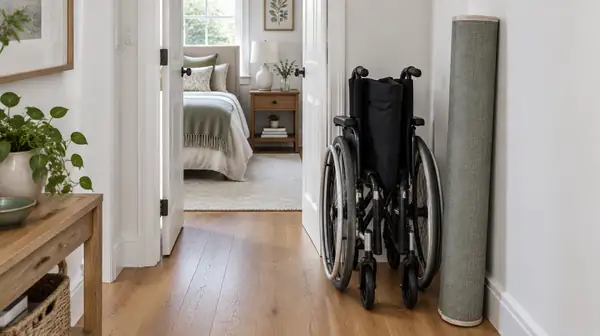
- Access for wheelchair users and people with mobility limitations: the Housing Enabler rates how well the home fits the person's limitations, which is closer to a modification question than a falls screen.
- Dementia: the HEAP-R is built for these homes and involves the caregiver in the walk-through.
- Aging-in-place and modification intake: CASPAR records goals, problem tasks, photos and measurements in a form that a contractor or designer can work from.
- Outcome measurement: the SAFER-HOME developers describe it as "sensitive in detecting changes," and the I-HOPE was piloted before and after a barrier removal intervention, so both suit before-and-after comparisons.
A hazard screen and a performance measure answer different questions: the first shows where hazards are, the second shows which ones affect the person's daily activities. The validation studies above were done with older adults, so check that your client group matches before relying on a total score.
A home hazard tool covers only the environment. Falls have several causes, so pair it with a falls risk assessment of the person, such as the CDC's STEADI approach for older adults, which screens gait, strength, balance, medications and vision. A 2023 Cochrane review found home hazard programs reduce falls when they are aimed at people at higher risk of falling and include assessment and follow-up, not a checklist alone (Clemson et al., PubMed 36893804).
Common questions
Is the Westmead Home Safety Assessment free?
No. The WeHSA is sold by Coordinates Publishing as the Home Fall Hazards kit, with the manual, 25 assessment forms, 25 safety report forms and a laminated prompt sheet. Check the publisher's page for the current price.
Which home safety assessment can a client complete without a therapist?
The HSSAT, from the University at Buffalo, is written for older adults and their families and is free to download. HOME FAST also has an 87-item self-report version, HOME FAST-SR, described in the University of Sydney manual.
Can I adapt or translate the I-HOPE?
No, not under the standard permission. Washington University's copyright notice permits use of the I-HOPE "exactly as it appears here without modification or editing of any kind," and excludes derivative works, including translations.
Which tools were developed in Canada?
The SAFER-HOME was developed in Canada at COTA, and its v.3 manual is sold through VHA Home HealthCare. The HSSAT and I-HOPE are from US universities, CASPAR from Georgia Tech and a US company, the HEAP from US researchers, the WeHSA and HOME FAST from Australia, and the Housing Enabler from Sweden.
Sources
- Chiu T, Oliver R. Factor analysis and construct validity of the SAFER-HOME. OTJR: Occupation, Participation and Health, 2006;26(4):132 to 142.
- Breeden LE. Occupational therapy home safety intervention via telehealth. International Journal of Telerehabilitation, 2016;8(1):29 to 40. PubMed 27563389.
- VHA Home HealthCare. Publications for sale: Safer Home Manual V.3. Checked October 2026.
- University at Buffalo, Department of Rehabilitation Science. Home Safety Self-Assessment Tool (HSSAT), Version 5.0. Checked October 2026.
- Tomita MR, Saharan S, Rajendran S, Nochajski SM, Schweitzer JA. Psychometrics of the Home Safety Self-Assessment Tool (HSSAT). American Journal of Occupational Therapy, 2014;68(6):711 to 718. PubMed 25397766.
- Coordinates Publishing. Home Fall Hazards (Westmead Home Safety Assessment). Checked October 2026.
- Clemson L, Fitzgerald MH, Heard R. Content validity of an assessment tool to identify home fall hazards: the Westmead Home Safety Assessment. British Journal of Occupational Therapy, 1999;62(4):171 to 179.
- Clemson L, Fitzgerald MH, Heard R, Cumming RG. Inter-rater reliability of a home fall hazards assessment tool. Occupational Therapy Journal of Research, 1999;19(2):83 to 98.
- Washington University in St. Louis, Participation, Environment and Performance Laboratory. In-Home Occupational Performance Evaluation (I-HOPE) and copyright notice and permission statement. Checked October 2026.
- Stark SL, Somerville EK, Morris JC. In-Home Occupational Performance Evaluation (I-HOPE). American Journal of Occupational Therapy, 2010;64(4):580 to 589. PubMed 20825129.
- homemods.org. Comprehensive Assessment and Solution Process for Aging Residents (CASPAR) and the CASPAR form (PDF), sections 1.0 to 6.0. Checked October 2026.
- Sanford JA, Pynoos J, Tejral A, Browne A. Development of a comprehensive assessment for delivery of home modifications. Physical and Occupational Therapy in Geriatrics, 2002;20(2):43 to 55.
- Mackenzie L, Byles J, Higginbotham N. Reliability of the Home Falls and Accidents Screening Tool (HOME FAST). Disability and Rehabilitation, 2002;24(5):266 to 274. PubMed 12004972.
- Hassani Mehraban A, Mackenzie LA, Byles JE. A self-report home environment screening tool identified older women at risk of falls. Journal of Clinical Epidemiology, 2011;64(2):191 to 199. PubMed 20554430.
- Mackenzie L. Home Falls and Accidents Screening Tool (HOME FAST) Manual. University of Sydney, 2019. Checked October 2026.
- Romli MH, Mackenzie L, Lovarini M, Tan MP, Clemson L. The clinimetric properties of instruments measuring home hazards for older people at risk of falling: a systematic review. Evaluation and the Health Professions, 2018;41(1):82 to 128. PubMed 29415567.
- Rantakokko M, Törmäkangas T, Rantanen T, Haak M, Iwarsson S. Environmental barriers, person-environment fit and mortality among community-dwelling very old people. BMC Public Health, 2013;13:783.
- Rantanen T, et al. Individual and environmental factors underlying life space of older people: study protocol and design of a cohort study on life-space mobility in old age (LISPE). BMC Public Health, 2012;12:1018.
- Iwarsson S, Nygren C, Slaug B. Cross-national and multi-professional inter-rater reliability of the Housing Enabler. Scandinavian Journal of Occupational Therapy, 2005;12:29 to 39.
- Helle T, et al. The Nordic Housing Enabler: inter-rater reliability in cross-Nordic occupational therapy practice. Scandinavian Journal of Occupational Therapy, 2010;17(4):258 to 266.
- Gitlin LN, Schinfeld S, Winter L, Corcoran M, Boyce AA, Hauck W. Evaluating home environments of persons with dementia: interrater reliability and validity of the Home Environmental Assessment Protocol (HEAP). Disability and Rehabilitation, 2002;24(1-3):59 to 71.
- University of Florida, I-DAPT. Home Environmental Assessment Protocol-Revised (HEAP-R). Checked October 2026.
- Struckmeyer LR, Pickens N, Brown D, Mitchell K. Home Environmental Assessment Protocol-Revised initial psychometrics: a pilot study. OTJR, 2020;40(3):175 to 182.
- Clemson L, et al. Environmental interventions for preventing falls in older people living in the community. Cochrane Database of Systematic Reviews, 2023, CD013258.
- Centers for Disease Control and Prevention. STEADI: Stopping Elderly Accidents, Deaths and Injuries. Checked October 2026.
Spotted an error? Read our corrections policy.
Cite as: Home Adapt Guide Team. (2026, October 15). Home safety assessments for OTs compared: SAFER-HOME, HSSAT, WeHSA and more. Home Adapt Guide. https://homeadaptguide.com/checklists/home-safety-assessments/